
Storm damage cleanup in Baytown, TX
Wind, rain, and storm surge off Galveston Bay damage a house in three different ways, and insurance treats them differently too.
Call Now 24/7(832) 688-652224/7 emergency line. Free estimates from local pros.
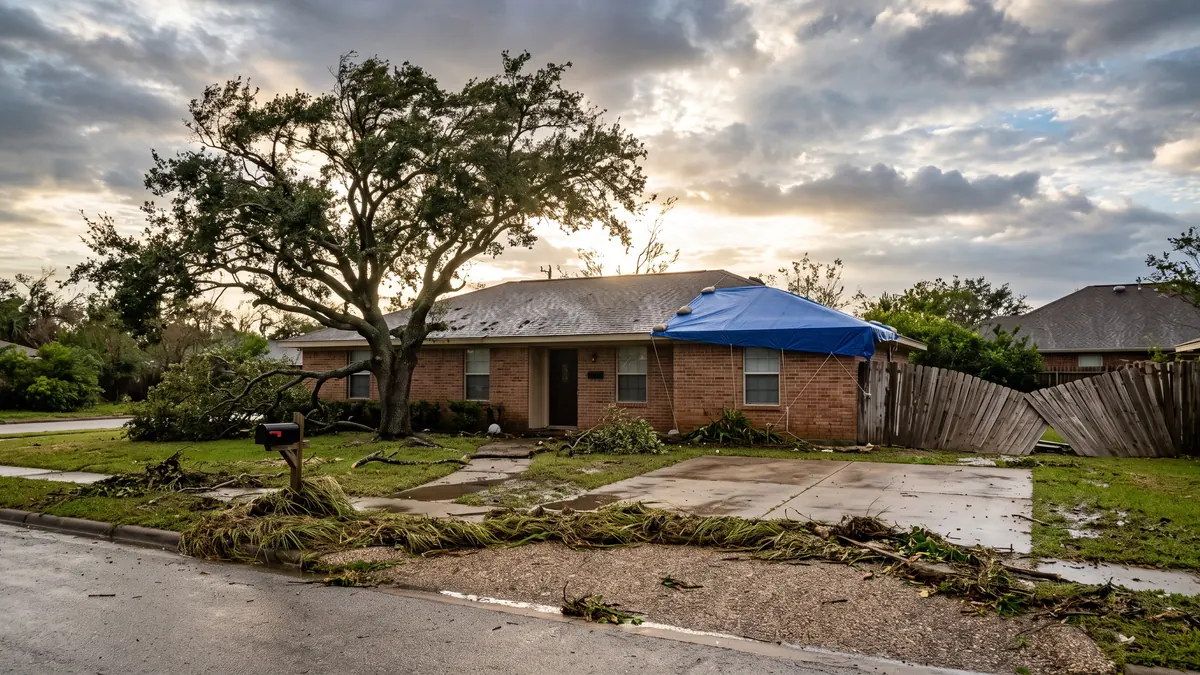
Wind tears a hole. Rain finds it. On Galveston Bay, a third kind of water can show up too: storm surge, pushed in off the bay itself, and it doesn’t behave like either one.
Once the wind lets up enough to move around safely, call then, not after a full day spent trying to dry things out alone. Nobody can promise exactly when someone reaches your street. What we can do is answer now, not tomorrow.
Tarp goes on before drying starts
Wind opens a hole somewhere, a missing shingle, a cracked window, a section of soffit torn loose, and rain finds it fast. The first move is covering that opening, a tarp, plastic sheeting, whatever stops more water from getting in, done safely and only from the ground or a stable spot. Drying what’s already wet comes after the opening is covered, not before. Trying to dry a room while rain is still finding its way in through the same hole just resets the clock. Once the wind and rain move on, what to do after water damage steps through what comes next.
Surge is its own kind of water
Storm surge isn’t rain, and it isn’t a bayou spilling its banks either. It’s Galveston Bay itself, pushed inland by wind, and it carries salt and silt instead of just fresh water. Coming home to a surge-soaked house after an evacuation means something rain never leaves behind: salt residue, silt worked into the carpet, a smell that doesn’t lift with the first cleaning.
Hurricane Ike proved the point in 2008. The storm’s surge reached a 17.5-foot high-water mark about ten miles inland in Chambers County, with parts of southern Chambers County taking more than 10 feet of water. That’s not rain. That’s the bay, pushed inland.
Baytown has its own proof that this isn’t hypothetical. Brownwood, a bayfront neighborhood on Burnet, Crystal, and Scott bays, spent decades sinking as groundwater pumping drained the ground underneath it, roughly ten feet by the early 1980s. Hurricane Alicia’s storm surge in 1983 finished what the subsidence had started. The roughly 300 to 400 homes there were eventually bought out, and the peninsula is now the Baytown Nature Center.
TWIA coverage splits at Cedar Bayou
TWIA, the state’s insurer of last resort for wind and hail, doesn’t treat every part of Baytown the same way. Chambers County is one of Texas’s 14 first-tier coastal counties, and the whole county falls inside TWIA’s eligible area. That includes the stretch of Baytown east of Cedar Bayou. Harris County works differently. TWIA names five specific Harris County cities east of Highway 146 as eligible: La Porte, Morgan’s Point, Pasadena, Seabrook, and Shore Acres. Baytown isn’t one of them. That leaves most of the city, the Harris County side, including the historic downtown core, outside TWIA’s coverage area.
TWIA only ever pays for wind and hail. It doesn’t cover flood damage or water that gets in some other way, on either side of the bayou.
Wind gets one policy, water gets another
Wind damage and water damage can come from the exact same storm and still end up on two different insurance tracks. A shingle torn loose by wind is usually a homeowners claim. Water that rises up from the bay or a swollen bayou usually isn’t, no matter which storm brought it. The homeowners insurance guide compares how those two tracks actually work, and flood cleanup steps through the rising-water side, where the rules shift the moment the source is the bay and not the sky.
Common questions
Does TWIA cover every part of Baytown the same way?
No, and that surprises a lot of people. The Chambers County side of Baytown, east of Cedar Bayou, sits inside TWIA's coverage area because Chambers is a first-tier coastal county. The Harris County side, including the historic downtown core, isn't on TWIA's list of eligible Harris County areas. Either way, TWIA only covers wind and hail, never flood or general water damage.
Does a tarp count as fixing the problem, or just buying time?
Buying time, mostly. A tarp keeps more water from getting in while you sort out the rest, but it isn't a repair. The roof or window still needs an actual fix, and whatever got wet before the tarp went up still needs to dry out.
Does storm surge damage get treated like flood damage or like storm damage?
Neither one cleanly, which is part of what makes it confusing. Surge is water pushed in by wind off the bay, so some adjusters look at it close to how they'd look at flooding. TWIA itself never pays for it either way, since TWIA covers wind and hail only. Your homeowners or flood policy, whichever one applies, is where that conversation actually happens.
How do I know if wind or water actually did the damage?
Where the water shows up first is usually the clue. Water that tracks down from the roof or in around a window points to wind. Water that comes up from the floor, especially if it carries mud or debris, points to rising water instead. Either way, it's worth writing down what you saw and when, in case it matters for a claim later.
Related pages
Appliance leak cleanup
Most water heaters warn you first, a rust tint, a damp ring, a slow drip, before they actually let go.
Learn more →Burst pipe cleanup
When a pipe splits, water goes everywhere at once, most often here during a hard freeze.
Learn more →Ceiling water damage
By the time you see a stain on the ceiling, the water that made it already finished moving.
Learn more →Commercial Water Damage
Baytown's commercial water damage runs through strip retail, offices, and warehouses, not the refineries next door.
Learn more →Talk to a local pro now
We answer 24/7. One call gets a Baytown crew moving on your water damage, with a free estimate and help with your insurance claim.
Call Now 24/7(832) 688-6522Free estimates. No obligation to hire.