
Burst pipe water damage cleanup in Baytown, TX
When a pipe splits, water goes everywhere at once, most often here during a hard freeze.
Call Now 24/7(832) 688-652224/7 emergency line. Free estimates from local pros.
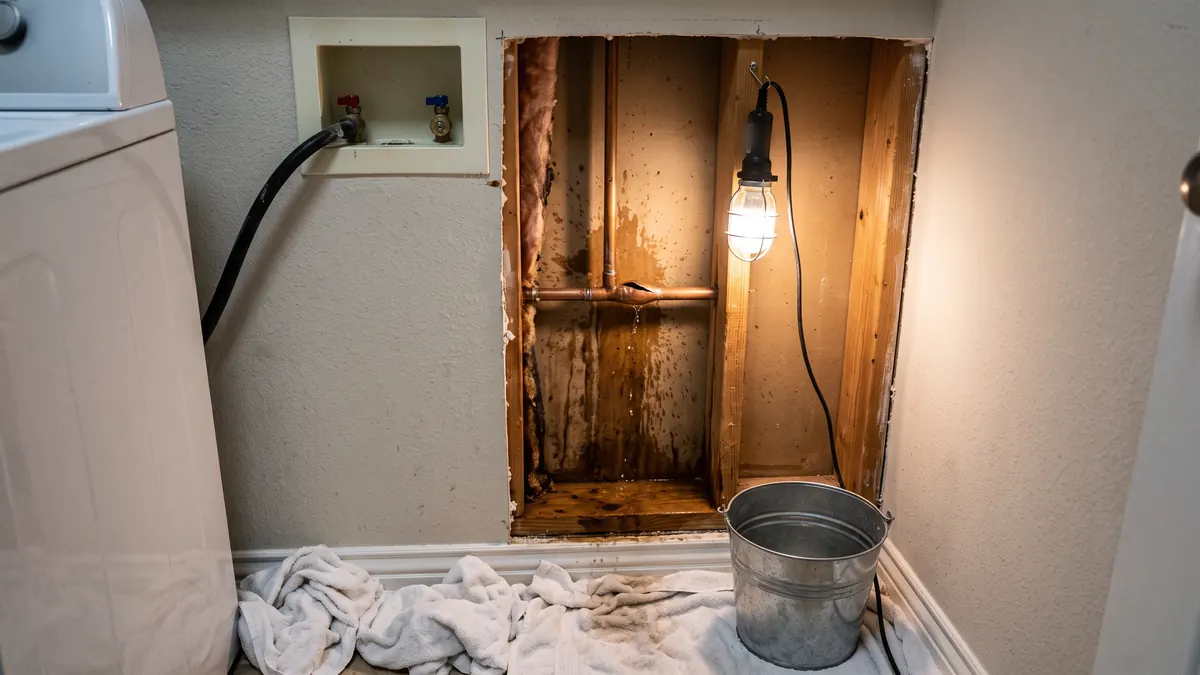
A pipe splits, and water goes wherever gravity and the floor plan send it. In Baytown, that split usually traces back to one thing: a hard freeze catching a line that was never built to handle ice. Here’s what to do the moment you find it, and what happens after the water’s off.
Cut the flow before you count the damage
The moment you see water that shouldn’t be there, go turn off the valve that feeds your whole house. You don’t need to find the exact spot where the pipe let go first. Shutting the main stops the flow everywhere at once, and that beats hunting for the break right now. If you already know which line failed and its own valve is easy to reach, close just that one instead. That keeps water running everywhere else in the house. Either way, stop the water before you do anything else, including cleanup.
What actually splits the pipe
Freezing water takes up more room than liquid water does. Once ice forms inside a length of pipe, the water still trapped behind it has nowhere to go. Pressure builds until something gives, and usually that something is the pipe wall itself, not the ice plug. Texas plumbing wasn’t built with the insulation a colder state needs. When a hard freeze actually settles in, houses here take a hit that houses farther north rarely see. The pipe doesn’t have to freeze solid everywhere, either. One cold stretch in one section is often all it takes.
The freeze didn’t stop at broken pipes
Baytown got a second problem during Winter Storm Uri in February 2021, on top of every burst-pipe call the city took that week: a citywide boil-water notice. If your own pipes held up that week, you likely still remember boiling water for the tap anyway. Both problems trace back to the same cause. A hard freeze that lasts long enough finds every weak point in a water system, not just the ones behind your walls.
Behind the drywall, the water’s still there
Turning the water off doesn’t finish the job. Water that already got into a wall cavity keeps sitting there. It soaks into the drywall paper and the framing behind it, long after the leak itself stops. Insurers usually read a sudden break like this as accidental damage, which tends to work in your favor — the homeowners insurance guide gets specific about the difference between sudden and gradual damage. Drying the space right means pulling moisture out from inside the wall, not just wiping down what you can reach with a towel.
Shutoff is a location, not a skill
You don’t have to be a plumber to shut off a supply line. It’s a spot in your house, something you can find on a calm afternoon and remember later, not a skill you learn for the first time under pressure. Stop the water first. That part is yours. Call us next, and we hand your specific damage off to a local company from there. If the water actually came up from under the slab instead of out of a wall, the slab leak page tackles that version of the problem instead. Why certain homes freeze and others don’t is what the frozen pipe guide pins down.
Common questions
Will insurance treat my burst pipe as an accident?
Most Texas policies treat a sudden pipe failure as accidental, covered damage, since nothing about it points to neglect. The exact wording and any exclusions still depend on your own policy. The homeowners insurance guide draws the line between sudden and gradual damage in more detail.
Do I have to leave the water shut off until it's fixed?
Yes, until a plumber closes the leak or replaces the damaged section. Turning the main back on before the pipe is actually fixed just starts the flood over again. If you need water somewhere else in the house, ask whoever's fixing it whether a partial shutoff is possible.
How can I tell a burst pipe from a slab leak?
A burst pipe usually announces itself fast, water pooling or spraying somewhere you can see it. A slab leak is quieter: a warm spot on the floor, a water bill that climbed for no clear reason, sometimes no visible water at all. If you're not seeing an obvious source, the slab leak page is worth a look instead.
Does the wall need to be cut open to dry out?
Not always. If the moisture stayed limited and equipment can reach it, some walls dry in place. If water sat too long or traveled too far inside the cavity, the wet section usually has to come out. Either way, that call gets made after someone's actually looked at how far the water traveled.
Related pages
Appliance leak cleanup
Most water heaters warn you first, a rust tint, a damp ring, a slow drip, before they actually let go.
Learn more →Ceiling water damage
By the time you see a stain on the ceiling, the water that made it already finished moving.
Learn more →Commercial Water Damage
Baytown's commercial water damage runs through strip retail, offices, and warehouses, not the refineries next door.
Learn more →Emergency water removal
Standing water spreads through floors, walls, and everything in between fast, and getting it out is the whole job.
Learn more →Talk to a local pro now
We answer 24/7. One call gets a Baytown crew moving on your water damage, with a free estimate and help with your insurance claim.
Call Now 24/7(832) 688-6522Free estimates. No obligation to hire.