
Ceiling water damage repair in Baytown, TX
By the time you see a stain on the ceiling, the water that made it already finished moving.
Call Now 24/7(832) 688-652224/7 emergency line. Free estimates from local pros.
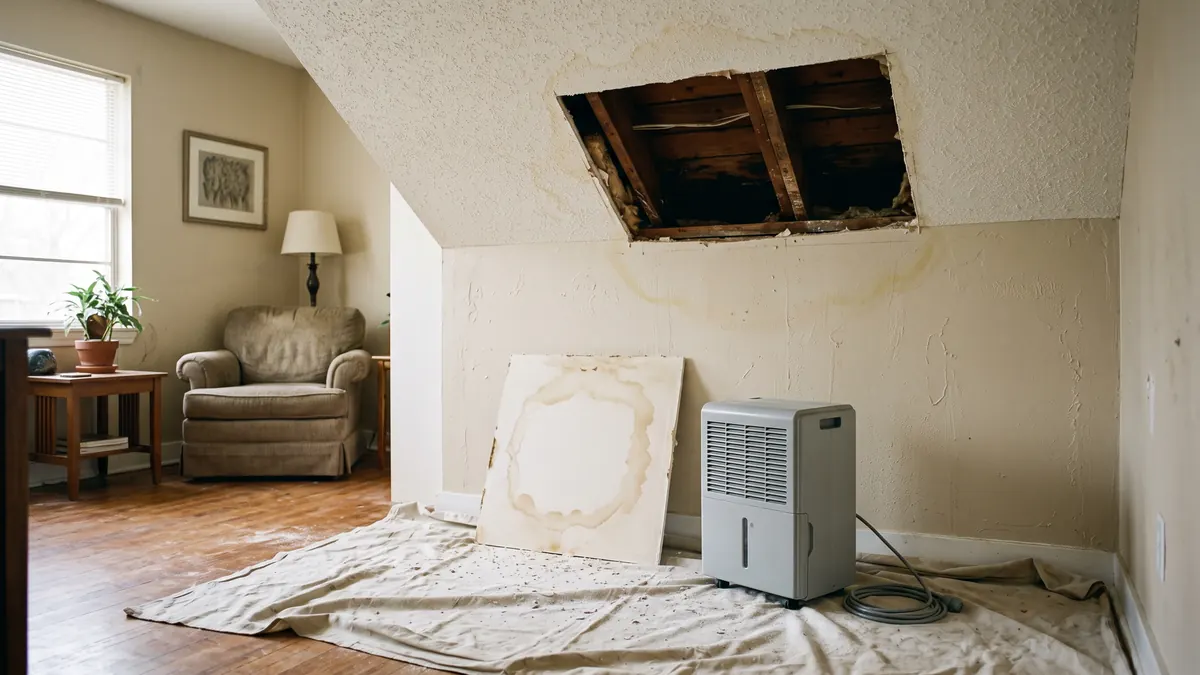
A stain on your ceiling isn’t new information by the time you see it. The water that made it started somewhere else, days or weeks earlier, and finished its trip through drywall and paint before you ever looked up. What you’re dealing with right now comes down to one of three things: a drip that’s still active, a stain that’s already dried, or a sag that means water is still sitting up there. Each one calls for something different.
Drip, stain, or sag: which one is this?
An active drip means water is still moving somewhere above you right now, not old evidence. Get a container under it fast, and treat it like the emergency it is: the emergency water removal page has the next steps for water that’s actively spreading. A stain with no drip and a flat, dry surface is different. That’s water that already came and went, sometimes weeks ago, and the ceiling has had time to dry out on its own. A sag or a soft spot is its own category entirely, because it means water is still up there right now, not just evidence that it once was.
A bulge changes the rules
A flat stain is old news, water that already dried. A bulge or a soft, sagging spot is different: that’s standing water the ceiling material is currently holding up, and it’s heavier than it looks. Don’t stand directly under it, and don’t push up into it to check how bad it is. If a light fixture sits anywhere near the wet area, cut the power to it at the breaker before you do anything else. Water and electricity sharing a ceiling cavity is a real risk, not a small one. If you do need to relieve the pressure before help arrives, put a bucket under it first and let it drain through a small opening, not directly onto anything you don’t want to lose.
Where the water actually started
In most Texas homes, ceiling water traces back to one of three places. An attic AC air handler with a drain pan that’s clogged or overflowing is the most common culprit through a Baytown summer, when the system barely shuts off. Most of those pans have a float switch meant to shut the whole system down before it overflows, but a switch that’s stuck, unplugged, or simply worn out won’t catch anything. A failed roof penetration, a vent boot or a section of flashing that’s given out, is another common source. So is a bathroom or shower pan on the floor above, if your house has a second story. If the stain lines up with a supply vent or an air handler closet, the AC condensate overflow guide pins down exactly how that drain system is supposed to work and where it usually fails.
Not every wet ceiling comes down
A ceiling that stayed damp only briefly, and dries fast with the right equipment, can sometimes stay in place, texture and all. One that soaked long enough to sag, bubble, or come apart at a seam usually has to come out, patched or replaced instead of dried. Texture is harder to match than flat drywall, which is worth knowing before anyone cuts out more than they need to. Once the water’s confirmed stopped, the water damage repair page makes sense of which path fits: dry in place, cut and patch, or full replacement.
Gravity gives you a preview
A ceiling doesn’t hide much once gravity gets involved. Water that’s up there works its way down, and what you’re seeing right now, a drip, a stain, a bulge, is only a preview of what’s happening above it. You don’t need to know the cause before you call. A bucket already catching drips, or a stain that’s grown since yesterday, is reason enough on its own. The rest is a local company’s job to work out: what’s actually up there, how far it traveled, and what it’ll take to fix.
Common questions
Can this just get painted over?
Only once you're sure the water's actually stopped and the area is dry. Paint hides the color, but it won't tell you whether the source is fixed, and covering an active problem just delays finding out. If the stain hasn't grown or darkened in a while and the cause is already fixed, paint is usually the last step, not a shortcut around the first ones.
Should I pop the bulge myself?
Only if you're careful about where the water goes and what's underneath it. Cut power to any nearby light first, put a bucket under the spot, and let it drain through a small opening rather than pushing on it. If you're not confident doing that safely, it's fine to leave it alone and get someone to look at it instead.
Who do I actually call to fix the ceiling itself?
It depends on what caused it. A roofer fixes a failed roof penetration, an HVAC company takes care of a condensate drain or float switch, and a plumber closes a leak from an upstairs bathroom. The ceiling material itself, the drywall or texture, is usually separate work once the source is stopped.
Does the attic insulation need attention too?
Often, yes. Water usually soaks the insulation above a ceiling before it ever shows up as a stain below, so insulation that got wet is worth checking even if the ceiling itself looks fine. Wet insulation that stays wet loses some of its effectiveness and can hold moisture longer than the drywall does.
Related pages
Appliance leak cleanup
Most water heaters warn you first, a rust tint, a damp ring, a slow drip, before they actually let go.
Learn more →Burst pipe cleanup
When a pipe splits, water goes everywhere at once, most often here during a hard freeze.
Learn more →Commercial Water Damage
Baytown's commercial water damage runs through strip retail, offices, and warehouses, not the refineries next door.
Learn more →Emergency water removal
Standing water spreads through floors, walls, and everything in between fast, and getting it out is the whole job.
Learn more →Talk to a local pro now
We answer 24/7. One call gets a Baytown crew moving on your water damage, with a free estimate and help with your insurance claim.
Call Now 24/7(832) 688-6522Free estimates. No obligation to hire.