
Emergency water removal in Baytown, TX
Standing water spreads through floors, walls, and everything in between fast, and getting it out is the whole job.
Call Now 24/7(832) 688-652224/7 emergency line. Free estimates from local pros.
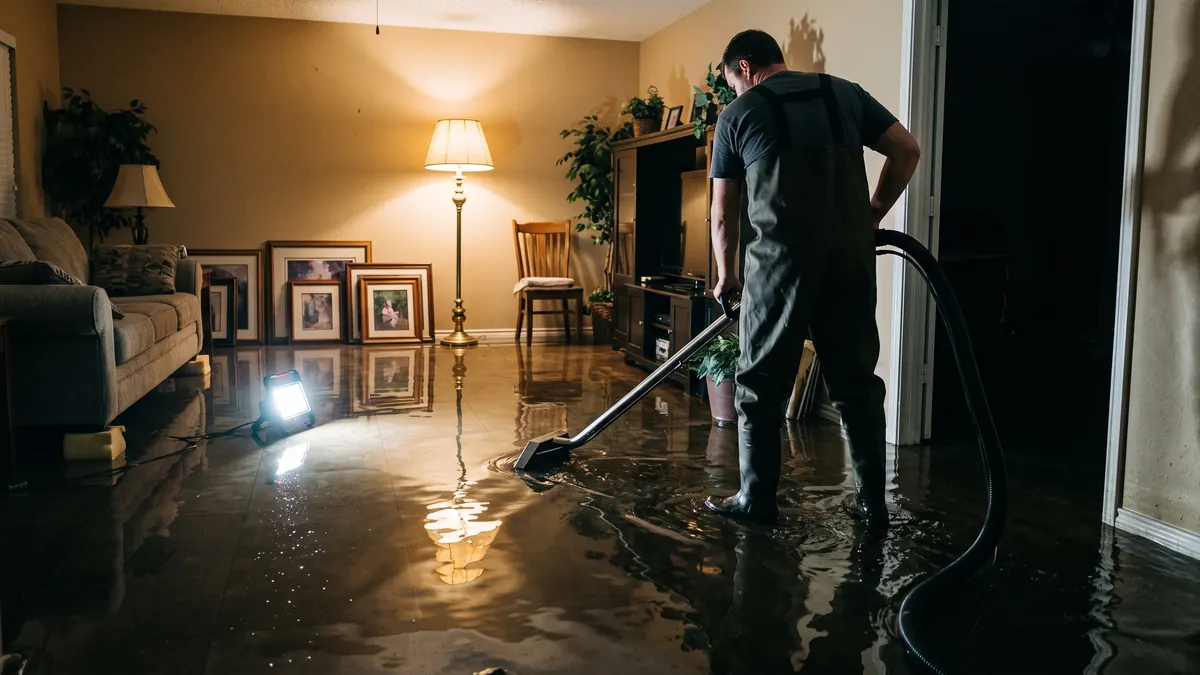
Emergency water removal is the extraction stage: standing water leaves your floors fast, before it works deeper into everything it’s touching. In a Baytown home, that’s usually floors first, then walls, then whatever furniture or boxes are still sitting in it. Here’s what happens to each, and what actually stops it.
What standing water does to your floor first
Water settles at the lowest point in a room and stays there until something moves it. Carpet pulls it upward into the pad underneath, which holds far more water than it looks like from the surface. Hardwood and laminate can swell and cup within a single day. Tile holds up fine on top, but water can slip through the grout lines and pool underneath it.
Then it works into your walls
Drywall soaks up water from the bottom edge the way a paper towel takes up a spill. Left long enough, that moisture reaches the insulation and framing behind it, out of sight. Baseboards trap water against the wall and slow down any air trying to dry that spot on its own.
Your furniture and boxes are next
Wood furniture legs pull water upward the same way drywall does. Cardboard loses its strength fast once the bottom layer is wet, and whatever’s stored inside goes down with the box. Upholstered furniture holds water deep inside, where a hand on the surface won’t tell you much.
Cut the water first, then decide what to move
Two things matter before anything else: stopping the water, and getting the right items off the floor, in that order.
- Find the shutoff for the fixture or line that failed, and close it. If the source isn’t obvious, close the home’s main shutoff instead.
- Cut power at the breaker to any outlet or fixture sitting in standing water. Don’t touch a wet switch by hand.
- Move anything with legs off wet carpet first: chairs, tables, anything light enough to lift safely.
- Get boxes and paper off the floor next, before the cardboard gives out.
- Leave rugs and cushions for later. They can wait, and your back shouldn’t have to.
Camera first, cleanup second
Take pictures of the water, the source if it’s visible, and anything it’s already touched. Do this before you carry off a single item or wipe up a drop of it. Insurers want to see what actually happened, not a tidied-up version of it after the fact.
Extraction, then measuring, then the machines that finish it
Getting standing water out comes first, usually with a pump or a unit strong enough to pull gallons out fast. Moisture mapping comes next: a meter checks drywall, subfloor, and framing to find out exactly how far the water traveled, not just where the stain shows. Air movers and a dehumidifier go wherever that meter says it’s still wet. The mold math starts at hour zero, the moment something got wet, not the moment anyone noticed it.
A rented extractor gets you partway there
Hardware stores and some grocery chains rent carpet extractors by the day, and one of those can pull surface water out of carpet well enough on its own. What it can’t do is check whether the pad underneath is still soaked, whether water reached the drywall behind a baseboard, or when a wall is actually dry enough to close back up. That’s the machine already in your garage. What a call brings is the meter that checks the wall, not just the floor, and equipment sized to finish a job instead of only starting one.
What extraction actually buys you
Extraction by itself doesn’t fix anything. What it buys is time: drier framing, a drier subfloor, and a shorter list of what has to be torn out later. Once the water’s out and equipment is running, the next set of decisions belongs to the water damage repair page: what gets fixed and what gets replaced. If you’re not sure what comes before any of this, what to do after water damage does the math on the first hour, and the drying time guide clears up how long the equipment actually needs to keep running.
Common questions
Will someone actually answer if I call after midnight?
Yes. This number is answered any time, including well after midnight. What happens next depends on who's already working nearby that night, so nobody honest gives you an exact number of minutes. Calling as soon as you notice water is what actually helps, whatever the clock says.
What's a realistic timeline for getting a house like mine dry?
It depends mostly on how much got wet and how long it sat before drying started. A single wet room with fast extraction can be close to dry within a few days. A house with more rooms involved, or water that sat longer before anyone caught it, takes longer than that.
Can my family keep living in the house while it dries?
In most cases, yes, especially if only one or two rooms are affected and the rest of the house has power and stays dry. If air movers and a dehumidifier end up running in a bedroom or the only bathroom, that changes the answer. It's worth asking directly once someone's looked at what's actually wet.
Is it safe to leave the power on where the water is?
Not if water is touching an outlet, a switch, or anything plugged in. Cut power to that area at the breaker before you walk through it, rather than flipping a switch by hand. If you're not sure which breaker controls that room, treat the whole panel as off-limits until you are.
Related pages
Appliance leak cleanup
Most water heaters warn you first, a rust tint, a damp ring, a slow drip, before they actually let go.
Learn more →Burst pipe cleanup
When a pipe splits, water goes everywhere at once, most often here during a hard freeze.
Learn more →Ceiling water damage
By the time you see a stain on the ceiling, the water that made it already finished moving.
Learn more →Commercial Water Damage
Baytown's commercial water damage runs through strip retail, offices, and warehouses, not the refineries next door.
Learn more →Talk to a local pro now
We answer 24/7. One call gets a Baytown crew moving on your water damage, with a free estimate and help with your insurance claim.
Call Now 24/7(832) 688-6522Free estimates. No obligation to hire.